
Tree Root Investigation & Mapping Wollongong
Non-Destructive Root Investigation, AirSpade Excavation and CAD Root Mapping
Need to know exactly where a tree’s roots actually are?
Wollongong Tree Permit Services provides Tree Root Investigation and Mapping across the Wollongong Local Government Area, using non-destructive techniques to identify significant roots while minimising unnecessary damage.
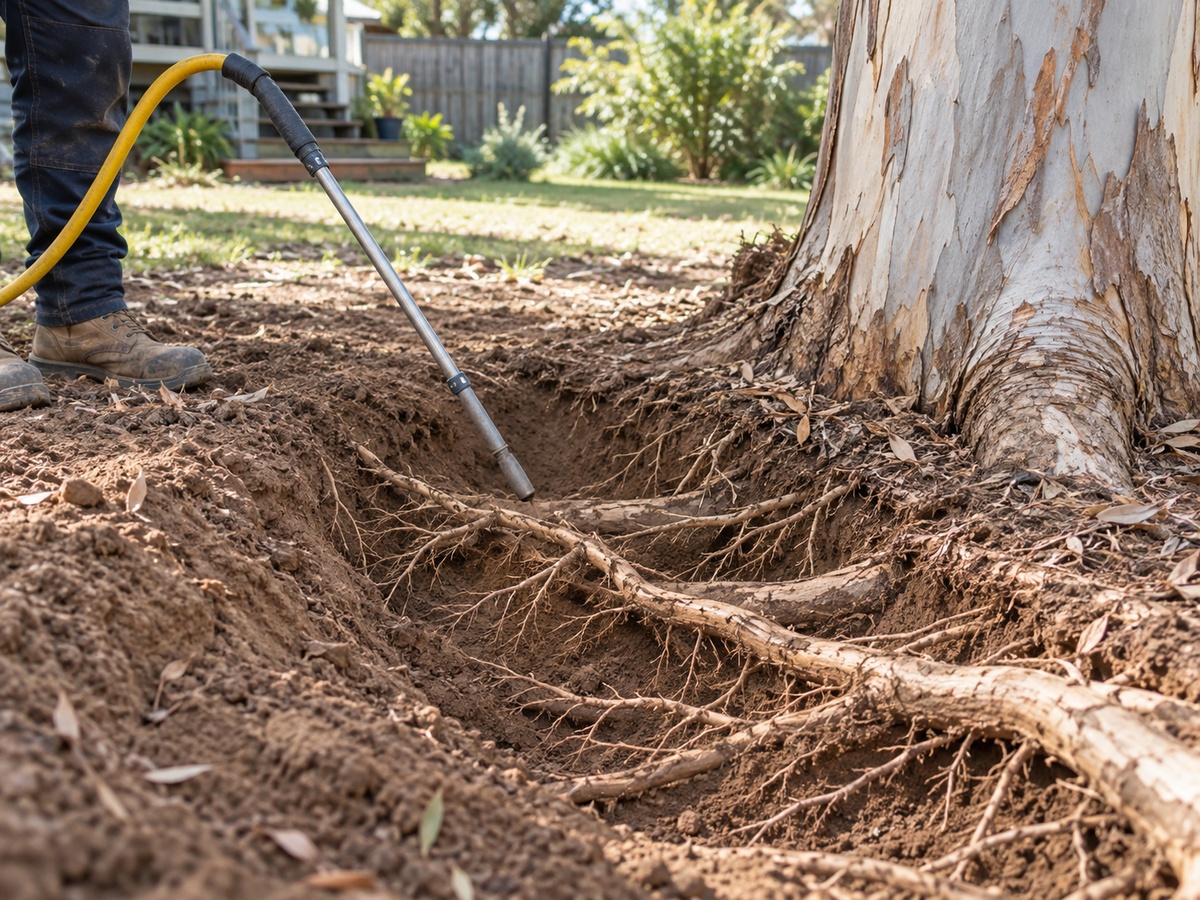
This matters wherever proposed buildings, footings, driveways, pools, retaining walls, services or excavation interact with a retained tree’s root zone. Using AirSpade excavation where required, roots can be exposed, measured, photographed and mapped against the proposed works, physical evidence, not an assumption based on where the trunk happens to sit.
This is particularly relevant in Wollongong: Chapter E17 requires a Tree Protection Zone for retained trees, and specifically restricts excavation, footings, retaining walls and services within it.
What Is a Tree Root Investigation?
Root location and distribution can’t be reliably determined from above ground. A root investigation physically checks selected soil areas to establish whether significant roots are present and how they relate to proposed works, buildings, driveways, pools, retaining walls, services, excavation or a proposed root-pruning location.
Establishing this before design decisions are locked in can determine whether the works can proceed as planned, or whether they need adjusting. For development sites, findings add physical evidence to the broader Arboricultural Impact Assessment.
What Is an AirSpade Root Investigation?
An AirSpade uses compressed air to remove soil from around roots, exposing selected areas without conventional mechanical excavation cutting through the root zone.
It can establish whether roots are present, where significant ones sit, their approximate diameter and depth, and whether they extend through a proposed excavation area. That’s genuinely useful evidence when an architect, engineer or arborist needs to make a call on a footing, driveway or service trench location.
What Is CAD Root Mapping?
Once roots are exposed and measured, findings can be mapped against architectural, engineering or survey information, building footprints, footings, driveways, retaining walls, pools, services and other proposed works.
This gives the project team actual below-ground evidence to work from, rather than relying solely on theoretical TPZ/SRZ calculations.
What Does a Wollongong Root Investigation Report Document?
Significant root locations can also be transferred onto development or survey plans where appropriate.
Note: Chapter E17 doesn’t prescribe a fixed root-diameter reporting threshold, the scope of investigation and reporting responds to the individual development and Council requirement, not a fixed figure.
Why Do Tree Roots Matter for a Wollongong DA?
Where Council determines a tree is to be retained, a Tree Protection Zone must stay clear of buildings, footings, excavation, retaining walls, material storage, services, level changes and hard surfaces.
That’s why below-ground conflicts matter as much as above-ground ones, a building can clear the trunk entirely while its footings or services still interact with the root system. Root investigation supplies the physical evidence to check that properly, rather than assuming it based on canopy position.
Root investigation supports (but doesn’t replace) the Development Arborist Report or AIA, it adds physical evidence where root location or significance genuinely needs to be better understood, for footing decisions, excavation planning, driveway design, service alignment, or Tree Protection Plans.
What Happens When Significant Roots Are Found?
Finding roots doesn’t automatically stop a development. Significance depends on root size, location, depth, distribution, and their relationship to the tree and the proposed works.
Where roots do conflict with the design, the usual response is one of:
- Repositioning works
- Modifying footings
- Redirecting services
- Adjusting excavation
- Alternative construction methods
- Reviewing proposed root pruning
The goal is evidence that informs the design before excavation starts, not a discovery made after the fact.
Can Root Investigation Change a Building or Driveway Design?
Yes, and this can be one of its most useful applications. Chapter E17 expressly contemplates modifying building and driveway layouts where existing trees are affected.
If a potential conflict is caught while the design can still change, physical evidence lets the project team consider moving a footprint, changing a footing location, adjusting a driveway alignment, relocating a service, reducing excavation, or reassessing a proposed encroachment.
This is a far better position than discovering significant roots after the design is already approved.
Roots Suspected of Damaging a Driveway, Building or Sewer
Visible cracking, displacement or lifting doesn’t by itself prove a tree caused the damage. Root investigation establishes whether roots are actually present in the affected area, but where structural movement or soil behaviour is the real question, engineering assessment may also be needed.
Sewer damage is a specific case.
Where a tree is alleged to have damaged a sewer, Chapter E17 identifies written evidence from a licensed plumber as the relevant supporting information. Root investigation confirms whether roots are physically present, it doesn’t replace the plumbing evidence.
Licensed plumber evidence + Arboricultural root investigation
, often both are needed, since a nearby tree alone doesn’t establish the cause of a sewer problem.
For removal matters involving suspected root damage:
Can I Just Cut Roots That Are in the Way?
No, don’t assume so.
Chapter E17 is explicit: pruning of major structural roots or anchor roots is subject to a Permit. Cutting significant roots without understanding their function can affect a tree’s water and nutrient uptake, structural support and stability.
Where roots conflict with proposed work, the right response is investigation, design modification, or an approval pathway, not simply cutting them.
Root Investigation During Construction
Ideally, investigation happens before design and excavation are finalised, but unexpected roots do turn up mid-build. Where that happens, the Project Arborist assesses root size, location, significance and the impact of continuing excavation before any decision is made. Roots shouldn’t be severed automatically just because they’re in the way.
When Should Root Investigation Happen?
For development projects: before final design and excavation, ideally. Early investigation lets actual root evidence shape building footprints, footing systems, driveway alignments, service locations and excavation extent, while the design can still respond to it.
It can still happen during construction if unexpected roots are found, but earlier is always more useful to the design team.
Working With Your Project Team
Root investigation is most valuable when the findings actually get used. We work alongside architects, structural and civil engineers, builders, developers, principal certifiers, surveyors, town planners and landscape architects, folding below-ground tree constraints into the broader design and assessment process rather than leaving them as a separate document nobody reads.
Tree Root Investigation Throughout Wollongong
- Ward 1: Northern WollongongTree Root Investigation and Mapping throughout Helensburgh, Stanwell Park, Coledale, Austinmer, Thirroul, Bulli, Woonona and Corrimal, plus the northern parts of Fairy Meadow, Balgownie and North Wollongong.
- Ward 2: Wollongong & FigtreeAirSpade Root Investigation and CAD Root Mapping throughout Wollongong, Gwynneville, Keiraville, Figtree, West Wollongong and Mount Kembla, plus the southern parts of Fairy Meadow, Balgownie and North Wollongong.
- Ward 3: Dapto & Southern WollongongTree Root Investigation and Mapping throughout Dapto, Horsley, Wongawilli, Berkeley, Port Kembla, Windang, Coniston, Spring Hill, Lake Heights and Dombarton.
Some suburbs sit across a ward boundary, see Council's ward search to confirm. All suburbs listed fall within the Wollongong City Council LGA.
Why Choose Wollongong Tree Permit Services?
Consulting Arborists
Development-focused root assessment and arboricultural reporting.
AirSpade Root Investigation
Non-destructive root exposure where physical investigation is required.
CAD Root Mapping
Significant root locations mapped against proposed development.
Physical Evidence, Not Assumptions
Establishing where roots actually occur, rather than guessing from canopy position.
Development & Design Coordination
Practical information for architects, engineers, builders and other consultants.
Project Arborist Continuity
Investigation findings can carry through into construction-stage monitoring and tree protection.
32+ Years’ Arboricultural Experience
Practical arboricultural assessment and development experience.
Frequently Asked Questions
When is a Tree Root Investigation needed?
Where proposed excavation, construction or an existing structure interacts with a tree’s root zone and the actual location or significance of roots needs establishing.
Can you locate roots without damaging them?
AirSpade excavation uses compressed air to expose roots while minimising the damage conventional mechanical excavation would cause.
What information can it provide?
Root location, diameter, depth and distribution, and how significant roots relate to proposed works.
Can root investigation help with a Wollongong DA?
Yes, it adds physical root evidence to an AIA, design review, TPZ/SRZ assessment or other development arboricultural work.
Can root investigation help retain a tree?
Yes, physical evidence can let architects and engineers adjust building locations, footings, driveways, services or excavation methods while keeping the tree.
Can you tell if roots are affecting my driveway or building?
Investigation establishes whether roots are physically present and their relationship to the structure. Engineering assessment may still be needed to confirm the cause of structural movement.
Can I cut major roots if they’re in the way of my driveway?
No, Chapter E17 specifically requires a Permit for pruning major structural roots or anchor roots.
Can you map roots onto our development plans?
Yes, significant root locations can be incorporated into architectural, engineering or survey information.
Should this happen before my plans are finalised?
Ideally, yes, while the footprint, footings, driveway, services or excavation method can still be adjusted.
Need a Tree Root Investigation in Wollongong?
Send us your plans and photos of the tree, and we’ll provide a fixed quote for root investigation.
Get a Free Quote 0494 077 630