Tree Health & Safety Assessments Wollongong
Consulting Arborist Assessments for Tree Health, Structural Condition, Risk and Management
Concerned about the health, condition or safety of a tree in Wollongong?
Wollongong Tree Permit Services provides Tree Health & Safety Assessments for homeowners, strata, schools, businesses, property managers and other landowners across the Wollongong Local Government Area.
A tree can look unhealthy, have deadwood, cavities, cracking, storm damage or root problems without the right management response being obvious. We assess the tree, document its health and structural condition, and provide evidence-based recommendations, retention, pruning, further investigation, or removal.
Where Council requires professional supporting information, Chapter E17 identifies Level 5 Horticulture/Arboriculture, or equivalent, as part of the qualification requirements for an arborist preparing reports.
When Should I Get an Assessment?
Signs worth having checked:
- Declining canopy
- Extensive deadwood
- Cavities or decay
- Cracks or splits
- Weak branch attachments
- Previous branch failure
- Storm damage
- Significant lean
- Root damage or soil movement at the base
- Fungal fruiting bodies
- Construction impacts
- Proximity to people, buildings or vehicles
A concern doesn’t automatically mean removal, the point of the assessment is establishing the actual condition and the right response.
What Does the Assessment Examine?
Common defect types across canopy, branches, trunk, base and roots: Deadwood • Cracks • Splits • Cavities • Decay • Weak branch unions • Included bark • Previous failures • Root damage • Sudden lean • Root-plate movement. Some are visible on a ground-based inspection; others need closer or diagnostic investigation.
Does a Dangerous-Looking Tree Have to Be Removed?
No. A tree can have real defects and still be suitable for retention with the right management.
The call depends on defect severity and location, tree health, species characteristics, likelihood and consequence of failure, and surrounding targets, not simply that a tree is large, close to a building, or causing concern.
Cavities and Internal Decay
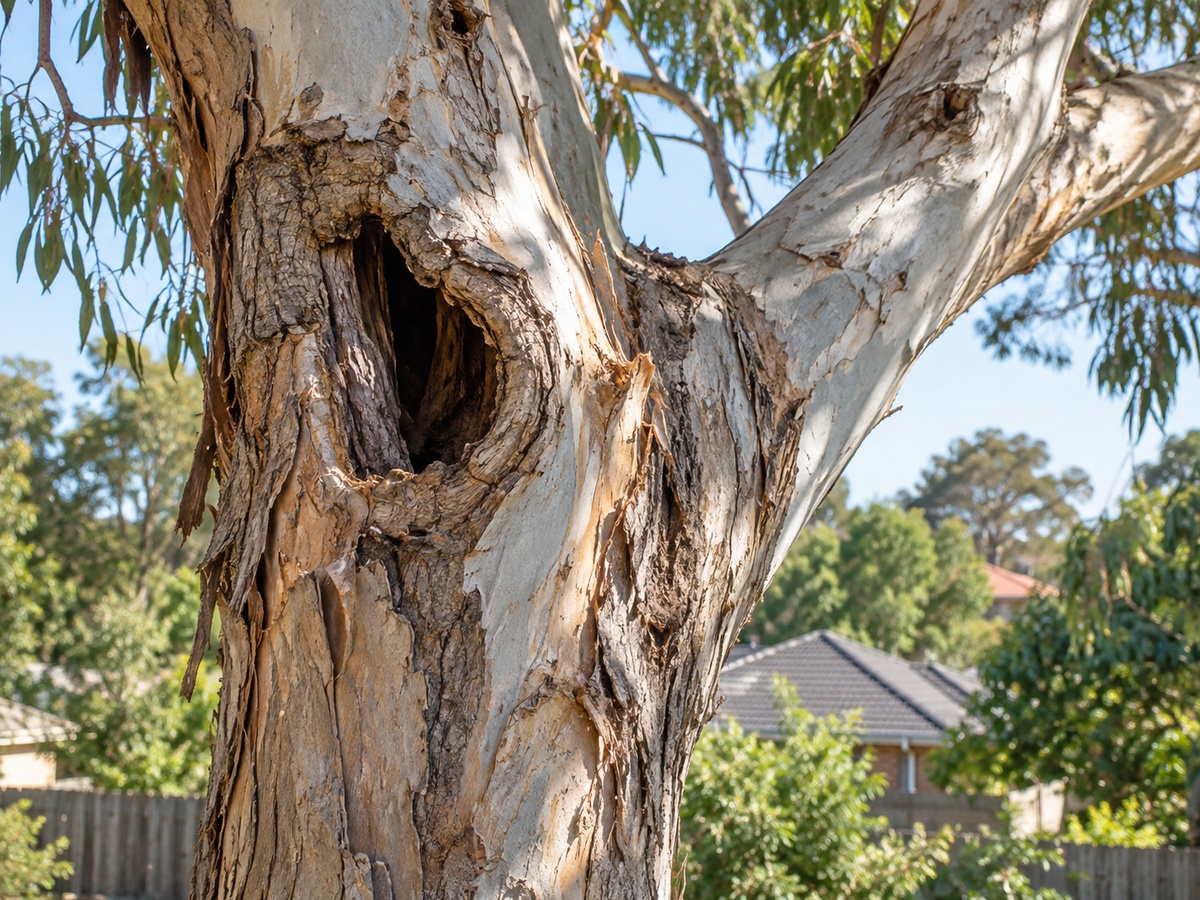
A cavity doesn’t automatically mean a tree is unsafe, and a trunk’s outside appearance doesn’t reveal how much internal decay is actually present.
We assess cavity size and location, associated wounds, fungal activity, remaining structural wood, tree form and loading. Where visual assessment isn’t enough, diagnostic testing, such as Resistograph testing, can add more information about internal wood condition, considered alongside the tree’s overall structure rather than as an isolated reading.
Resistograph testing uses a fine drilling needle to measure resistance through the wood, picking up density differences that suggest internal deterioration. It’s useful where significant decay is suspected, a cavity extends into the trunk, or visual assessment alone can’t define the issue, not every tree needs it, only where the result will genuinely help.
Root and Basal Concerns
Root and basal defects can affect both health and structural stability: damaged structural roots, root severance, nearby excavation, root decay, root-plate movement, soil cracking or lifting, and basal cavities all fall into this category.
Chapter E17 is explicit that pruning major structural roots or anchor roots is subject to a Permit, major roots shouldn’t be cut simply because they’re inconvenient or in the way of construction.
Where root location or condition needs physical investigation:
Roots Damaging a Driveway, Wall or Sewer?
Damage near a tree doesn’t automatically prove the tree caused it, the right evidence depends on what’s damaged.
Often more than one is needed together, rather than relying on surface damage alone to assume a cause.
Can an Arborist Report Support a Removal Application?
Yes, where professional evidence is required. A Health & Safety Assessment documents declining health, structural defects, decay, cavities, previous failures, root damage and instability, the arboricultural reasoning behind a removal recommendation, not just that the owner wants the tree gone.
Does a Dead or Dying Tree Still Need a Permit?
Yes, don’t assume otherwise.
Chapter E17 states plainly: a Permit is also required for any dead or dying tree. If a tree is dead, dying or severely declining, an assessment documents its condition and helps establish the right Council pathway.
What If the Tree Is Dangerous Right Now?
Different situation entirely, this needs the emergency pathway, not a planned assessment.
If the tree has actively failed, split, moved suddenly at the root plate, dropped a major limb, or fallen onto a structure:
If there’s no immediate threat, a planned assessment is the right starting point.
Can Pruning Make the Tree Safer?
Sometimes. Where the issue is localised, deadwood, a failed limb, excess weight on one section, targeted pruning can reduce the concern while keeping the tree. It has to respond to the actual defect, not act as an arbitrary percentage reduction or a substitute for removal where the structural issue genuinely can’t be managed that way.
Can a Tree Be Monitored Instead of Removed?
Yes, not every defect needs immediate action. Monitoring can suit a stable-but-present defect, a tree whose health is changing, decay that needs tracking over time, or a retained tree recovering after construction impact. The right interval depends on the individual tree, defect and risk context.
Tree Assessments for Schools, Strata and Commercial Properties
Properties with many trees or high public use often need a more systematic approach:
- Schools
- Strata Properties
- Commercial Sites
- Industrial Properties
- Childcare Centres
- Community Facilities
- Development Sites
Assessments identify trees needing urgent attention, defects requiring investigation, pruning priorities, and longer-term management priorities, for multiple trees, a tree schedule or management report gives property managers a clear working record.
Tree Health After Construction
Construction can affect a tree’s condition without any visible trunk damage, root severance, soil compaction, excavation, altered drainage and reduced rooting area all count. Chapter E17’s tree injury definition specifically covers root-zone damage from compaction, excavation, or unauthorised filling and stockpiling.
Where a retained tree shows decline during or after construction, assessment identifies the likely cause and the right response.
Tree Health & Safety Assessments Throughout Wollongong
- Ward 1: Northern WollongongTree Health & Safety Assessments throughout Helensburgh, Stanwell Park, Coledale, Austinmer, Thirroul, Bulli, Woonona and Corrimal, plus the northern parts of Fairy Meadow, Balgownie and North Wollongong.
- Ward 2: Wollongong & FigtreeTree health, structural and safety assessments throughout Wollongong, Gwynneville, Keiraville, Figtree, West Wollongong and Mount Kembla, plus the southern parts of Fairy Meadow, Balgownie and North Wollongong.
- Ward 3: Dapto & Southern WollongongTree health and structural assessments throughout Dapto, Horsley, Wongawilli, Berkeley, Port Kembla, Windang, Coniston, Spring Hill, Lake Heights and Dombarton.
Some suburbs sit across a ward boundary, see Council's ward search to confirm. All suburbs listed fall within the Wollongong City Council LGA.
Why Choose Wollongong Tree Permit Services?
Consulting Arborists
Professional assessment of tree health, structure, defects and management options.
Council-Ready Arborist Reports
Reports where professional supporting evidence is required.
32+ Years’ Arboricultural Experience
Practical experience assessing mature trees, defects, decay and management issues.
Diagnostic Investigation
Resistograph testing where internal wood condition needs further investigation.
Root Investigation Capability
AirSpade root investigation where below-ground conditions need establishing.
Retention or Removal Assessment
Evidence-based recommendations, not an outcome assumed before assessment.
Frequently Asked Questions
How do I know if my tree is dangerous?
Major deadwood, cracks, splits, cavities, recent movement, failed branches or root-plate disturbance are warning signs, but their significance depends on the individual tree and site. An assessment determines what they actually mean.
Does a cavity mean the tree must be removed?
No. Cavities vary in size, location and significance, the tree’s overall health, remaining wood and structure all matter too.
Can you test for internal decay?
Where appropriate, Resistograph testing can add information about internal wood condition when visual assessment alone isn’t enough.
Can an Arborist Report help me get approval to remove a tree?
Where Council requires professional supporting evidence, yes, the report documents health, structural condition, defects and recommendations.
Does Wollongong Council require a Level 5 arborist for reports?
Chapter E17 identifies Level 5 Horticulture/Arboriculture, or equivalent, as part of its qualification requirements for an arborist preparing reports.
Does a dead tree need a permit?
Yes. Chapter E17 specifically requires a Permit for any dead or dying tree.
Can pruning make a dangerous tree safe?
Sometimes, where the concern can be managed through targeted pruning. Other situations need further investigation, monitoring or removal.
What if the danger is immediate?
Use the Emergency Tree Removal pathway rather than waiting for a routine assessment.
How much does a Tree Health & Safety Assessment cost?
Typically $450–$900+, depending on the number of trees, complexity, and whether specialist investigation is required. We provide a fixed quote before work begins.
Concerned About a Tree in Wollongong?
Send us photos of the tree and a short description, and we’ll provide a fixed quote for an assessment.
Get a Free Quote 0494 077 630