Project Arborist Services Wollongong
Consulting Arborists Managing Tree Compliance from Development Approval to Project Completion
Need a Project Arborist for your Wollongong development?
Wollongong Tree Permit Services provides Project Arborist services across the Wollongong Local Government Area, helping builders, developers, architects, engineers, certifiers and project managers manage retained trees and arboricultural requirements during construction.
If your Development Consent requires an appointed Project Arborist, tree-protection inspections, excavation monitoring, arboricultural hold points or compliance documentation, we manage those requirements from pre-construction through to completion.
Where trees are determined for retention as part of a development, Chapter E17 requires a Tree Protection Zone to be established, with certification from an AQF Level 5 Arborist at specified construction stages.
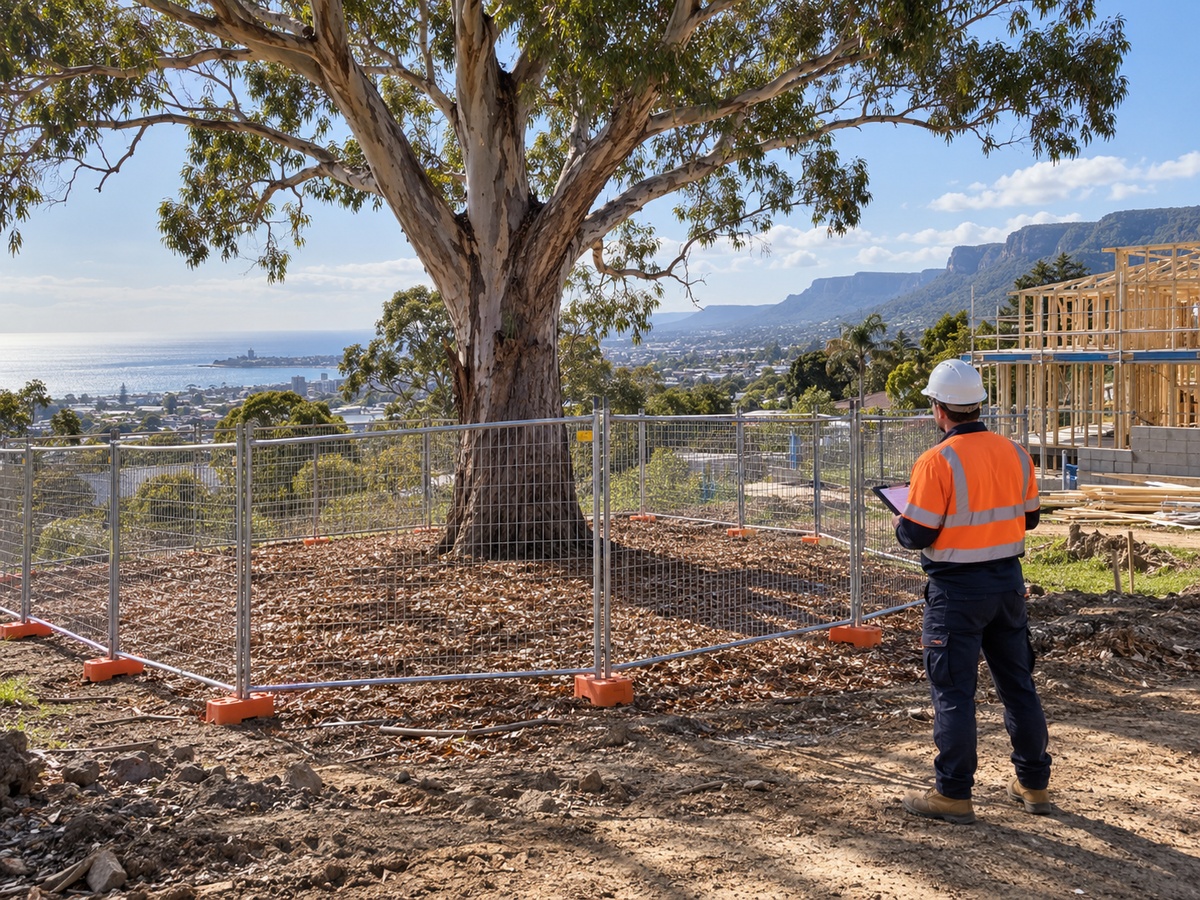
Wherever practicable, the same arborist who prepared your Development Arborist Report or AIA continues as Project Arborist, giving the project continuity from assessment through to completion.
What Does a Project Arborist Do?
Depending on the Development Consent and approved plans, this can include:
- reviewing arboricultural conditions of consent;
- inspecting tree-protection measures and Tree Protection Zones;
- attending required arboricultural hold points;
- supervising excavation near retained trees;
- assessing exposed or affected roots;
- monitoring approved root pruning;
- advising builders and contractors on site;
- maintaining inspection records; and
- providing arboricultural certification where required.
The goal is protecting retained trees while helping construction proceed within the approved plans and consent conditions.
Does Wollongong Council Require AQF Level 5 Certification During Construction?
Yes, where trees have been determined for retention as part of a development.
This makes the Project Arborist more than someone called to site when a problem develops, they provide the documented link between the approved tree-protection requirements and what actually happens during construction. Project-specific requirements still depend on the individual Development Consent.
When Should You Appoint a Project Arborist?
Before the first arboricultural condition or hold point is due, not after.
Early appointment lets us review the Development Consent, approved plans, the AIA or Development Arborist Report, the Tree Protection Plan, and the required inspections before work starts.
Common trigger points, before:
- Demolition
- Site establishment
- Tree-protection installation
- Excavation
- Driveway works
- Service installation
- Construction close to retained trees
Appointing the Project Arborist after work has already occurred can make it difficult, sometimes impossible, to verify a condition that required prior inspection.
Project Arborist Workflow
- 01Review Development Consent: approved plans, arboricultural reports and tree conditions, to identify requirements, inspections and hold points.
- 02Establish tree protection: required measures checked before relevant construction activities begin.
- 03Monitor construction: inspections carried out as work progresses near retained trees and their TPZs.
- 04Manage tree impacts: excavation, root exposure or unexpected site conditions assessed and documented.
- 05Report and certify: construction-stage reports and certification prepared where required.
What Must Stay Clear of the Tree Protection Zone?
Chapter E17 requires the TPZ to stay clear of:
- Buildings
- Footings
- Excavation
- Retaining walls
- Material storage
- Services
- Level changes
- Hard surfaces
This is a genuinely important Wollongong-specific point, tree protection isn’t just fencing around the trunk. Construction activity inside the protected area can affect roots, soil conditions and the tree’s long-term stability.
Construction Monitoring and Arboricultural Hold Points
Development Consent conditions can require Project Arborist involvement at specific stages. Hold points may occur before or during:
- Installation of tree-protection measures
- Demolition near retained trees
- Excavation within or near a TPZ
- Footing or foundation excavation
- Driveway construction
- Underground services
- Approved root pruning
- Final inspection of retained trees
The required inspections depend on the individual Development Consent, which is exactly why it needs reviewing before construction begins, not once an inspection is already due.
Excavation, Roots and Unexpected Tree Impacts
Where roots are encountered during approved works, we assess their size, location, structural significance, and relationship to the approved TPZ or SRZ, and whether the work can proceed as approved.
Chapter E17 is explicit that pruning of major structural roots or anchor roots is subject to a Permit. Roots encountered mid-construction shouldn’t simply be cut because they’re in the way.
Where more detail on root location or distribution is needed:
Site conditions that differ from the approved plans or arboricultural assumptions should also be documented.
What Happens if Tree Protection Is Breached?
Common breach scenarios: unauthorised excavation, machinery entering protected areas, fencing removed or moved, material storage inside the TPZ, unexpected root exposure, or construction differing from approved plans.
Where an issue is identified, we assess the tree and affected area, document the circumstances, and recommend appropriate measures. Early assessment beats letting further work continue without understanding the impact.
Compliance Reporting and Certification
Certification reflects the inspections actually carried out, if a condition requires inspection at a specific stage, we can’t retrospectively verify work completed before we attended. That’s one of the strongest reasons to appoint early.
Can the Same Arborist Continue From the AIA?
Yes, wherever practicable, and it’s worth doing.
The same arborist who prepared the Development Arborist Report or AIA already knows the assessed trees, the retention recommendations, the TPZ/SRZ relationships, and the reasoning behind the original recommendations.
Where another arborist prepared the original report, we can still take on the Project Arborist role after reviewing the approved documentation, consent and plans.
Can You Take Over as Project Arborist Mid-Construction?
Potentially, but we need the existing project record first: the Development Consent, approved plans, original report, Tree Protection Plan, previous inspection records and photographs, and current site conditions.
From there, we can identify which future requirements we can manage. What we can’t do is retrospectively certify an inspection or stage we didn’t witness, where the condition requires direct verification.
Development Projects and Project Teams
Residential, commercial, industrial, community and infrastructure developments throughout Wollongong:
- New Homes
- Extensions
- Dual Occupancies
- Townhouses
- Apartments
- Commercial Developments
- Industrial Sites
- Subdivisions
- Schools
- Childcare Centres
- Infrastructure Projects
We work alongside builders, developers, architects, engineers, principal certifiers, town planners, landscape architects, surveyors and utility contractors, integrating the arboricultural requirements for retained trees into the construction process.
Project Arborist Services Throughout Wollongong
- Ward 1: Northern WollongongProject Arborist services throughout Helensburgh, Stanwell Park, Coledale, Austinmer, Thirroul, Bulli, Woonona and Corrimal, plus the northern parts of Fairy Meadow, Balgownie and North Wollongong.
- Ward 2: Wollongong & FigtreeConstruction monitoring and Project Arborist services throughout Wollongong, Gwynneville, Keiraville, Figtree, West Wollongong and Mount Kembla, plus the southern parts of Fairy Meadow, Balgownie and North Wollongong.
- Ward 3: Dapto & Southern WollongongProject Arborist services throughout Dapto, Horsley, Wongawilli, Berkeley, Port Kembla, Windang, Coniston, Spring Hill, Lake Heights and Dombarton.
Some suburbs sit across a ward boundary, see Council's ward search to confirm. All suburbs listed fall within the Wollongong City Council LGA.
Why Choose Wollongong Tree Permit Services?
Consulting Arborists
Development and construction-stage arboricultural expertise aligned with Chapter E17’s requirements.
Continuity From AIA to Construction
Wherever practicable, the same arborist continues from assessment through construction.
Construction Compliance
Review of consent conditions, required inspections, hold points, reporting and certification.
Tree Protection & Root Assessment
Practical assessment where construction interacts with retained trees, TPZs, SRZs or roots.
Project Team Coordination
Clear arboricultural advice for builders, developers, architects, engineers and certifiers.
Construction-Stage Certification
AQF Level 5 Arborist certification at the relevant project stages.
32+ Years’ Arboricultural Experience
Practical experience across tree assessment, development and construction-stage arboriculture.
Frequently Asked Questions
When is a Project Arborist required?
Where Development Consent conditions require arboricultural supervision, tree-protection inspections, excavation monitoring, construction-stage reporting or compliance certification for retained trees. Chapter E17 also establishes AQF Level 5 certification requirements at specified stages where trees are determined for retention.
When should I appoint the Project Arborist?
Before the first required arboricultural hold point or tree-protection condition is due, so the Development Consent and requirements can be reviewed before site works begin.
Does Wollongong require Level 5 certification for construction sign-off?
Yes. Chapter E17 specifies certification from an AQF Level 5 Arborist at identified stages where trees are determined for retention.
Can the same arborist prepare the AIA and supervise construction?
Yes, wherever practicable, giving the project continuity between assessment and construction.
What inspections does a Project Arborist undertake?
This depends on the Development Consent, commonly tree-protection inspections, excavation and root monitoring, construction-stage hold points, unexpected impact assessment, and final inspection of retained trees.
What happens if roots are found during excavation?
Stop before cutting significant roots. We assess their size, location, significance to the tree, and relationship to the approved works first.
Can you provide compliance certification?
Yes, where required, reflecting the relevant consent conditions, approved plans, and inspections actually carried out.
Can you take over from another Project Arborist?
Potentially. We review the Development Consent, existing arboricultural documents, previous inspection records and site conditions first, then confirm what future requirements we can manage, but we can’t retrospectively certify stages we didn’t inspect.
Need a Project Arborist in Wollongong?
Send us your consent conditions and plans, and we’ll provide a fixed quote for Project Arborist services.
Get a Free Quote 0494 077 630