Tree Removal Wollongong
Council Permit Checks, Arborist Reports Where Required, Professional Tree Removal
Need a tree removed in Wollongong?
Wollongong Tree Permit Services provides tree removal assessment, Arborist Reports for Tree Removal where required, Council permit support and professional tree removal across the Wollongong Local Government Area.
Under Chapter E17 of the Wollongong DCP, a declared tree or declared vegetation cannot be cleared, pruned or removed without a Permit or development consent, unless an exemption applies.
Already been told “you need an arborist report”? Send us the Council request or photos of the tree first, we’ll confirm what’s actually required before you pay for anything unnecessary.
Do I Need a Permit to Remove a Tree in Wollongong?
Many trees in Wollongong require Council approval before removal, but the pathway depends on the tree, property and reason for removal.
A declared tree under Chapter E17 is one that is:
- 5 metres or more in height, or
- 300mm or more in diameter measured at ground level.
Either threshold is enough on its own.
For declared trees on non-rural land, a Permit Application generally applies where removal or pruning isn’t for new development and development consent doesn’t otherwise apply. But Wollongong’s controls also carry separate pathways for development, biodiversity, heritage and rural land, so the correct pathway should be confirmed before the tree comes down, not after.
What Trees Does Wollongong Council Actually Protect?
Size isn’t the only trigger. Chapter E17’s declared vegetation also covers:
This is why tree size alone doesn’t settle whether removal can proceed.
Our Wollongong Tree Removal Process
- 01Check the Council pathway: species, dimensions, location, condition and site circumstances assessed against Permit / DA / Exemption pathways.
- 02Arborist Report where required: not every tree needs one. Where evidence is required, health, structural condition, defects and recommendations are documented.
- 03Council approval where required: the report supports the Permit Application or DA where relevant.
- 04Professional tree removal: once approval or a lawful exemption is confirmed.
When Is an Arborist Report for Tree Removal Actually Needed?
Not automatically. Chapter E17 allows Council to request additional supporting information, which can include:
- an Arborist’s Report;
- a tree survey;
- a flora and fauna impact assessment;
- geotechnical or structural engineer’s reports;
- a bushfire assessment report;
- a plumber’s report;
- details of proposed root barriers; or
- medical evidence in certain quality-of-life circumstances.
A report is most likely to matter where removal is sought because of:
- Tree decline
- Structural defects
- Decay or cavities
- Instability
- Previous failures
- Root issues
- Property damage
- Safety concerns
- Retention suitability
- A specific Council request
Chapter E17 identifies Level 5 Horticulture/Arboriculture, or equivalent, as part of Council’s qualification requirements for an arborist preparing reports. Our Tree Removal Reports are prepared by Consulting Arborists holding these qualifications.
What Does a Wollongong Tree Removal Report Include?
Where visual assessment isn’t enough, specialist investigation may be appropriate.
Can I Remove an Exempt Tree Without a Permit?
Some species and circumstances are exempt, but the exemption needs to genuinely apply.
Chapter E17’s Exempt Tree Species List includes species such as Camphor Laurel, Cocos/Queen Palm, Liquidambar, Privet, Radiata Pine, Silky Oak, Umbrella Tree and Willow, among others in the full Appendix 1 list.
An exempt species isn’t automatically exempt in every circumstance, the DCP excludes heritage items, threatened ecological communities/habitat, and trees required to be retained under a development consent from the exemption, regardless of species.
Does the NSW 10/50 Rule Apply in Wollongong?
It can, for eligible properties.
Chapter E17 recognises clearing done under the NSW Rural Fire Service 10/50 Vegetation Clearing Scheme Code of Practice as an exemption from the ordinary Permit or DA requirement. That doesn’t mean every property qualifies, the property and the work must actually satisfy the scheme’s requirements.
Can I Remove a Dead or Dying Tree Without a Permit?
No, don’t assume this in Wollongong.
Chapter E17 states plainly: a Permit is also required for any dead or dying tree.
If the tree is dead, dying, declining or structurally compromised, send us photos and the property details so we can confirm the pathway.
What If the Tree Is Dangerous or Storm-Damaged?
Chapter E17 exempts make-safe work where there’s an immediate threat to people or property, during or within 48 hours of a severe weather event.
There’s a follow-up requirement, though: a Permit Application or DA must then be lodged within 72 hours of the emergency works for removal or further pruning on private land. “Emergency” isn’t a blanket exemption for removing a tree simply because it looks unsafe.
What If Tree Roots Are Damaging My House, Driveway or Pipes?
Roots near cracked paving, a driveway, a retaining wall or a sewer line don’t automatically prove the tree caused the damage.
Where a tree is alleged to have caused sewer damage, Chapter E17 specifically requires written evidence from a licensed plumber confirming the extent of the problem. Where root location itself needs establishing, non-destructive root investigation can provide the evidence.
Can I Remove a Tree Because It’s Close to My House?
Proximity alone isn’t an automatic exemption.
Wollongong’s three-metre provision is narrower than that: where Council has issued Development Consent for a structure, a tree with its base within three metres of that building may be removed without further application, but only once Council’s Tree Management Officer is satisfied the base is genuinely within that limit. It’s tied to an existing development consent, not a general “within 3 metres” rule.
Tree Removal as Part of a Development Application
Tree removal tied to development follows a different pathway from standalone removal.
A DA is required where declared tree or vegetation clearing forms part of other building work or development requiring a DA. Where removal has already been approved through the DA, a separate Permit isn’t required for that tree.
Development assessment may need to consider tree health, retention value, TPZ/SRZ, development impacts and tree-protection requirements.
Can Biodiversity or Heritage Controls Affect Removal?
Yes. Chapter E17’s declared vegetation categories include threatened species/ecological communities, heritage items and riparian areas.
Where native vegetation clearing exceeds the Biodiversity Offsets Scheme threshold, Council can’t simply issue the ordinary permit, a different pathway applies involving the NSW Native Vegetation Panel. This matters most on larger, environmentally constrained or escarpment properties.
Professional Tree Removal After Approval
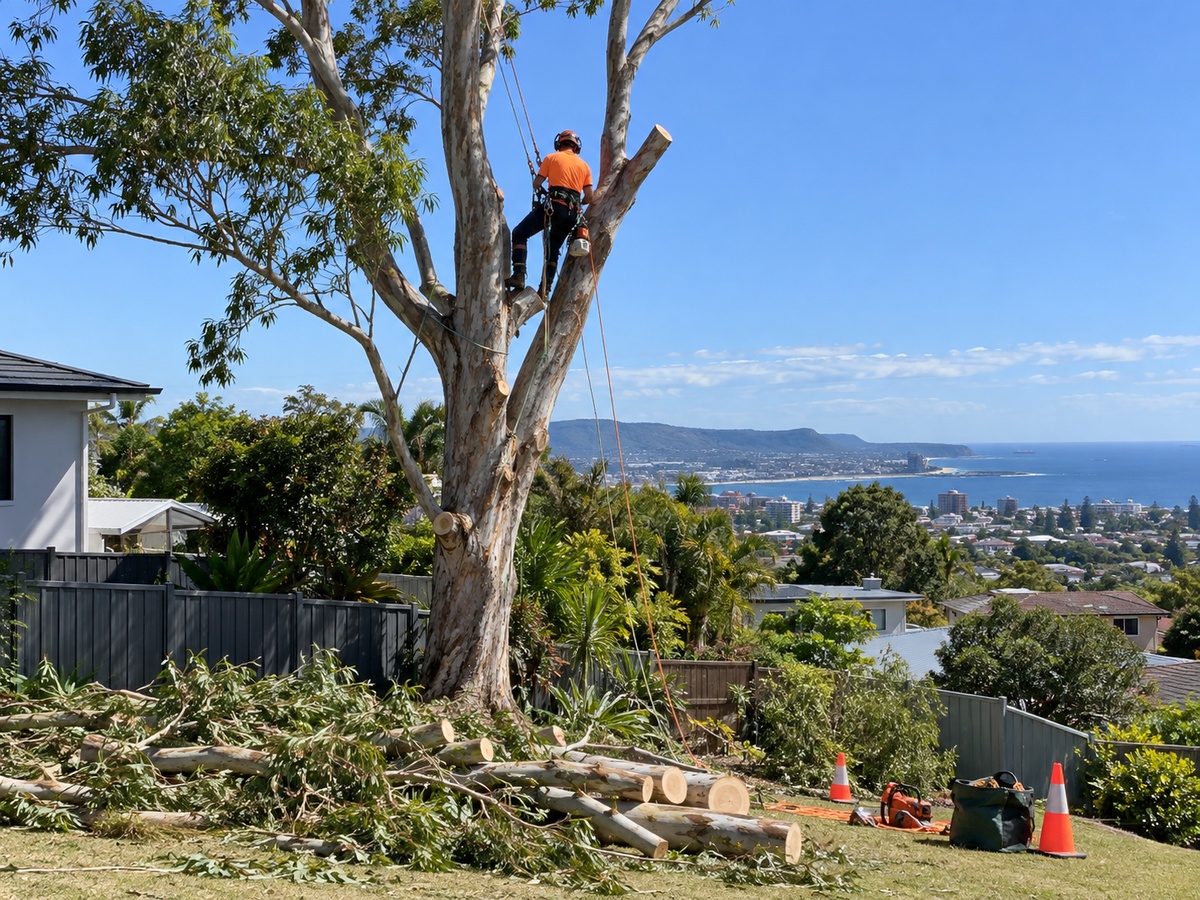
Once the pathway is confirmed and any required approval obtained, our tree crews carry out the work:
- Tree Dismantling
- Confined-Space Removal
- Large-Tree Removal
- Hazardous-Tree Removal
- Storm-Damaged Tree Removal
- Site Clean-Up
Tree Removal Throughout Wollongong
- Ward 1: Northern WollongongTree removal assessment and professional removal throughout Helensburgh, Stanwell Park, Coledale, Austinmer, Thirroul, Bulli, Woonona and Corrimal, plus the northern parts of Fairy Meadow, Balgownie and North Wollongong.
- Ward 2: Wollongong & FigtreeTree removal services throughout Wollongong, Gwynneville, Keiraville, Figtree, West Wollongong and Mount Kembla, plus the southern parts of Fairy Meadow, Balgownie and North Wollongong.
- Ward 3: Dapto & Southern WollongongTree assessment and removal throughout Dapto, Horsley, Wongawilli, Berkeley, Port Kembla, Windang, Coniston, Spring Hill, Lake Heights and Dombarton. Escarpment-adjacent and environmentally constrained properties in this ward can involve biodiversity or planning considerations beyond an ordinary tree permit.
Some suburbs sit across a ward boundary, see Council's ward search to confirm. All suburbs listed fall within the Wollongong City Council LGA.
Why Choose Wollongong Tree Permit Services?
Consulting Arborists
Council-ready assessments and Arborist Reports where required.
32+ Years’ Arboricultural Experience
Practical experience across tree assessment, risk, development and tree management.
Professional Tree Removal
Assessment and tree work through one coordinated service.
Council Pathway First
Not every tree needs an Arborist Report, we confirm what’s genuinely required before recommending it.
Tree Risk & Specialist Investigation
Root investigation where appropriate.
Emergency Response
Assistance for fallen, storm-damaged and immediately dangerous trees.
Frequently Asked Questions
Do I need a permit to remove a tree in Wollongong?
Most declared trees need Council approval unless an exemption or other lawful pathway applies. A declared tree is generally 5 metres or more in height, or 300mm or more in diameter at ground level.
Do I need an Arborist Report for tree removal?
Not always. Council may require additional professional information depending on the application. Where a report is required, Chapter E17 identifies Level 5 Horticulture/Arboriculture, or equivalent, as part of the qualification requirements.
Can you prepare the report and remove the tree?
Yes. We provide Arborist Reports where required and professional tree removal once the pathway is confirmed.
Can I remove a dead tree without a permit?
No. Chapter E17 specifically requires a Permit for any dead or dying tree.
What if my tree is dangerous right now?
Chapter E17 allows make-safe work where there’s an immediate threat, including during or shortly after severe weather, but follow-up Council application requirements still apply.
Does the 10/50 rule apply in Wollongong?
It can, for properties and work that genuinely qualify under the NSW RFS 10/50 Code, it isn’t automatic.
Is a tree within three metres of my house automatically exempt?
No. Wollongong’s three-metre provision applies only where Council has issued Development Consent for a structure, and only once the Tree Management Officer confirms the distance.
What if tree roots are damaging my house, driveway or pipes?
The cause should be established, not assumed. For alleged sewer damage, Chapter E17 specifically requires written evidence from a licensed plumber.
How much does a Tree Removal Report cost?
Tree Removal Reports typically range from $450–$900+, depending on the number of trees and site complexity. Professional tree removal is quoted separately based on size, condition, location, access and complexity. We provide a fixed quote before work begins.
Need a Tree Removed or an Arborist Report in Wollongong?
Send us photos of the tree and your address, and we’ll provide a fixed quote.
Get a Free Quote 0494 077 630