Development Arborist Reports Wollongong
Consulting Arborists for Development Applications, Arboricultural Impact Assessments and Construction Compliance
Planning a new home, extension, subdivision, driveway, commercial development or other building work where trees may be affected?
Wollongong Tree Permit Services prepares Council-ready Development Arborist Reports and Arboricultural Impact Assessments (AIAs) for development applications throughout the Wollongong Local Government Area.
Where existing trees or native vegetation occur on a development site, Wollongong City Council determines whether trees should be retained, removed, or whether the design of buildings and driveways needs to be modified. Chapter E17 of the Wollongong DCP states that the Development Application must be supported by an Arborist Report complying with Council’s requirements.
Already have plans or a Council request? Send them to us and we’ll identify the arboricultural assessment required and provide a clear quote before you proceed.
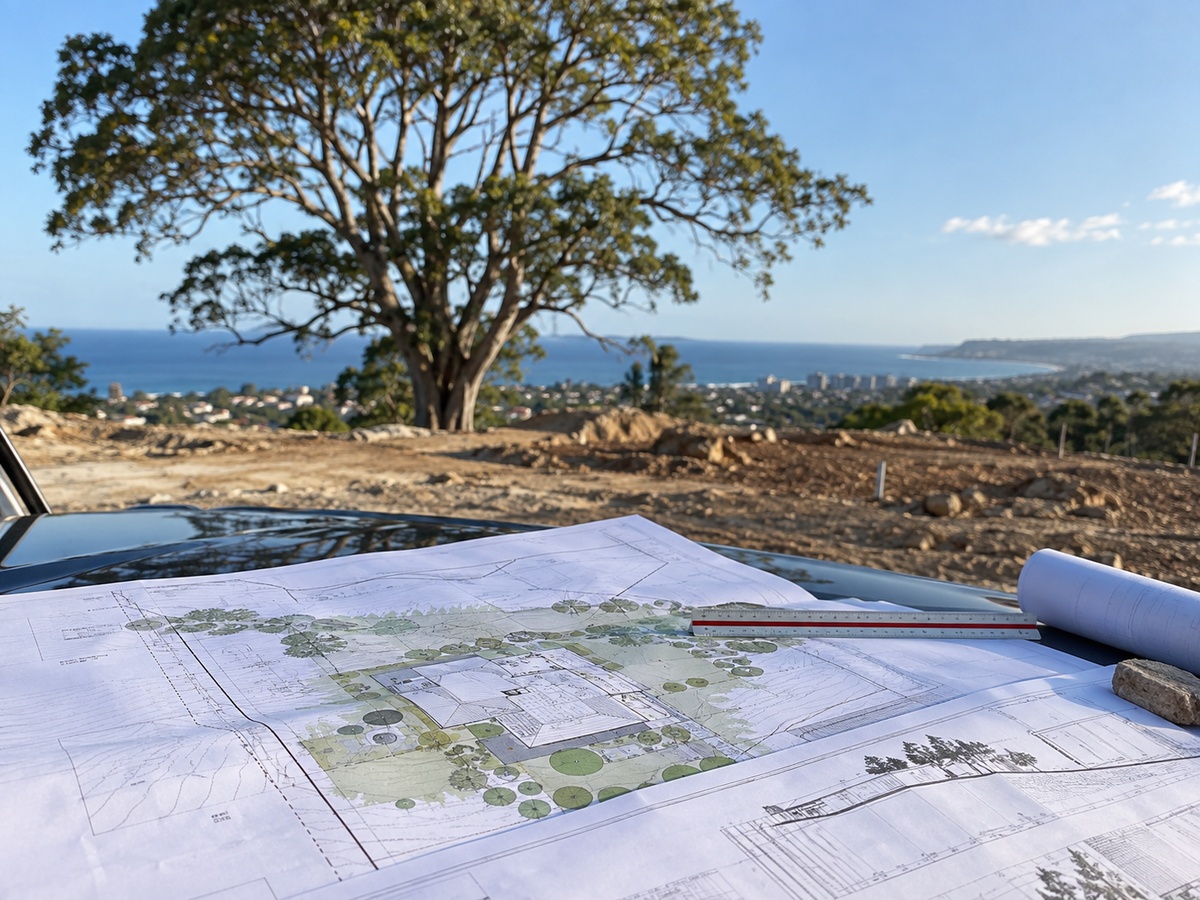
Do I Need an Arborist Report for My Wollongong Development Application?
An Arborist Report may be required where:
- new houses or major alterations are proposed near existing trees;
- extensions, dual occupancies or secondary dwellings are close to trees;
- a subdivision is proposed;
- garages or ancillary structures are planned near trees;
- driveways, access works or retaining walls interact with tree roots;
- excavation or changes in ground level may affect tree roots;
- services or infrastructure works are proposed near trees; or
- Wollongong City Council has requested arboricultural information.
Chapter E17 specifically contemplates modifications to the layout of buildings and driveways where existing trees are affected, so tree constraints can shape the design, not just the approval.
What Is an Arboricultural Impact Assessment?
An Arboricultural Impact Assessment (AIA) examines existing trees in relation to proposed development. Depending on the site, it may address:
- tree species, dimensions, health and structural condition;
- retention value;
- Tree Protection Zones (TPZ) and Structural Root Zones (SRZ);
- proposed building footprints, excavation, driveways, retaining walls and services;
- anticipated development encroachment into protection areas;
- tree retention or removal recommendations; and
- tree-protection requirements.
The report is not simply a tree list. It explains how the proposed development interacts with the trees and provides arboricultural recommendations Council can consider as part of the assessment.
What Trees and Vegetation Does Wollongong Council Protect?
Wollongong’s controls are broader than large trees alone.
A declared tree under Chapter E17 is one that is:
- 5 metres or more in height, or
- 300mm or more in diameter measured at ground level.
Either threshold is enough on its own.
Declared vegetation extends further, it can include native vegetation mapped under Council’s natural resources layer, vegetation forming habitat for threatened species or ecological communities, heritage vegetation, vegetation within an Aboriginal Place, and vegetation within a riparian corridor or waterfront land.
This means the correct pathway for a development can depend on more than the size of one tree.
Does Development Tree Removal Need a Tree Permit or a DA?
Not necessarily the same thing, and the distinction matters for a Wollongong development.
A Permit Application generally applies to a declared tree on non-rural land where the work is not for new development and development consent doesn’t otherwise apply.
A Development Application is required where the tree work forms part of a broader development, or involves heritage vegetation, or affects land covered by relevant environmental planning controls (such as mapped coastal wetlands or littoral rainforest).
Where removal has already been approved through a Development Application, Chapter E17 states a separate Permit is not required for that tree.
For a development project, the starting point should be establishing the correct pathway, not assuming a standard tree permit will cover it.
What Does a Wollongong Development Arborist Report Assess?
Should the Arborist Be Involved Before the Plans Are Finalised?
Ideally, yes.
Waiting until architectural or engineering plans are finalised can mean tree conflicts surface late in the DA process, when they’re expensive to fix.
Early assessment maps the chain:
- Tree
- TPZ/SRZ
- Proposed Development
- Potential Conflict
- Design Response
This gives architects, engineers and property owners the chance to work around tree constraints while the design can still change, particularly relevant in Wollongong, given Council’s DCP expressly contemplates layout modifications where trees are affected.
Can Wollongong Council Ask for Additional Arboricultural Information?
Yes. Chapter E17 provides that Council may require additional supporting information with an application, which can include:
- an Arborist’s Report;
- a tree survey;
- a flora and fauna impact assessment;
- geotechnical or structural engineer’s reports;
- a bushfire assessment report;
- a plumber’s report (where a tree is alleged to have damaged a sewer); and
- details of proposed root barriers.
An Arborist Report is one part of the evidence Council may require, the full scope depends on the particular issue raised by the development.
What Qualification Does Wollongong Council Require for an Arborist Report?
Chapter E17 identifies Level 5 Horticulture/Arboriculture, or equivalent, as part of Council’s requirements for an arborist who prepares reports. The DCP also requires eligibility for membership as a Consulting Arborist with the relevant professional bodies.
Our reports are prepared by Consulting Arborists holding these qualifications, directly aligned with what Wollongong Council’s own DCP specifies.
What Happens When Trees Are Retained During Construction?
Development consent isn’t the end of the arborist’s involvement.
Where Council determines trees are to be retained, Chapter E17 requires a Tree Protection Zone to be established. That area must stay clear of buildings, footings, excavation, retaining walls, material storage, services, level changes and hard surfaces.
Certification is required at three stages:
- Before construction
- During construction (midpoint, or as directed by the Project Arborist on jobs longer than six months)
- At completion
This creates a natural pathway from this report into our Tree Protection Plan and Project Arborist services.
What If the Development Encroaches Into a Tree Protection Zone?
A building doesn’t need to physically touch a tree to create an arboricultural issue. Impacts can arise from:
- excavation and footings;
- driveways and retaining walls;
- services;
- level changes;
- soil compaction; and
- construction access or material storage.
Where a design conflicts with the TPZ or SRZ, the arborist assesses the likely impact and determines what further investigation or protection measures are appropriate. Where root location is uncertain, root investigation and mapping can assist the project team.
Is an Arborist Report the Same as a Biodiversity Assessment?
No. An Arborist Report addresses trees from an arboricultural perspective.
Where native vegetation impacts on a Wollongong site trigger the Biodiversity Offsets Scheme threshold, Chapter E17 requires the DA to be accompanied by a separate Biodiversity Development Assessment Report, prepared by an accredited assessor, a distinct document from a Development Arborist Report.
How Does the Development Arborist Process Work?
- 01Send us your plans: architectural plans, survey and any Council correspondence.
- 02Site assessment: our arborist inspects the trees and the proposed development area.
- 03Arboricultural assessment: tree condition, retention value, TPZ, SRZ and development impacts.
- 04Report preparation: the appropriate Development Arborist Report or AIA is prepared.
- 05DA submission: the report forms part of the arboricultural documentation for your application.
- 06Construction-stage involvement: where required, we continue as Project Arborist through protection, inspections and certification.
Development Arborist Reports Throughout Wollongong
- Ward 1: Northern WollongongDevelopment Arborist Reports and AIAs throughout Helensburgh, Stanwell Park, Coledale, Austinmer, Thirroul, Bulli, Woonona and Corrimal, plus the northern parts of Fairy Meadow, Balgownie and North Wollongong.
- Ward 2: Wollongong & FigtreeDevelopment Arborist Reports and AIAs throughout Wollongong, Gwynneville, Keiraville, Figtree, West Wollongong and Mount Kembla, plus the southern parts of Fairy Meadow, Balgownie and North Wollongong.
- Ward 3: Dapto & Southern WollongongDevelopment Arborist Reports and AIAs throughout Dapto, Horsley, Wongawilli, Berkeley, Port Kembla, Windang, Coniston, Spring Hill, Lake Heights and Dombarton.
Some suburbs sit across a ward boundary, see Council's ward search to confirm. All suburbs listed fall within the Wollongong City Council LGA.
Why Choose Wollongong Tree Permit Services for Your Development?
Consulting Arborists
Council-ready reporting aligned to Chapter E17’s own qualification requirements.
32+ Years’ Experience
Practical arboricultural and development consulting experience.
Council-Ready AIAs
Reports prepared with reference to Wollongong’s DCP and applicable arboricultural standards.
Specialist Root Investigation
Root investigation and mapping where additional evidence is needed for a TPZ or SRZ conflict.
Continuity Through Construction
Tree Protection Plans, Project Arborist inspections and certification carried through to completion.
Fast-Track Available
Where project scheduling allows.
Frequently Asked Questions
Do I need an arborist report for a Wollongong DA?
It depends on the development and the trees or vegetation affected. Where existing trees or native vegetation are on a development site, Council determines their retention or removal and whether the design needs modification, and the DA must be supported by an Arborist Report complying with Council’s requirements.
What qualification does my arborist need?
Chapter E17 identifies Level 5 Horticulture/Arboriculture, or equivalent, as part of Council’s requirements for an arborist preparing reports.
Do I need a tree permit as well as a DA?
Not necessarily. If removal has already been approved as part of the Development Application, a separate Permit is not required for that tree.
Can an arborist help before my architect finishes the plans?
Yes. Early assessment can identify tree constraints, TPZ/SRZ conflicts and design issues before plans are locked in.
Can Council require trees to be retained?
Yes. Council’s development assessment considers whether trees should be retained, removed, or whether buildings and driveways need to be modified.
Do retained trees need arborist inspections during construction?
Where Chapter E17’s certification requirements apply, arborist certification is required before construction, during construction, and at completion.
How much does a Development Arborist Report cost?
Development Arborist Reports and AIAs generally start from $900+, depending on the number of trees, project complexity, available plans and Council requirements. We provide a fixed quote before work begins.
Need a Development Arborist Report in Wollongong?
Send us your survey and plans, and we’ll provide a fixed quote for your DA Arborist Report.
Get a Free Quote 0494 077 630