Emergency Tree Removal Wollongong
24/7 Emergency Tree Removal, Dangerous Tree Assessments, Make-Safe Services
Tree fallen? Storm damage? A tree threatening a house, car or driveway right now?
Wollongong Tree Permit Services provides 24/7 emergency tree response, make-safe work, dangerous tree assessment and arboricultural documentation across the Wollongong Local Government Area.
Chapter E17 of the Wollongong DCP contains a specific exemption for make-safe work where there’s an immediate threat of injury or property damage, during or within 48 hours of a severe weather event.
What Actually Qualifies as an Emergency?
An immediate threat to people or property, not a tree that simply looks concerning.
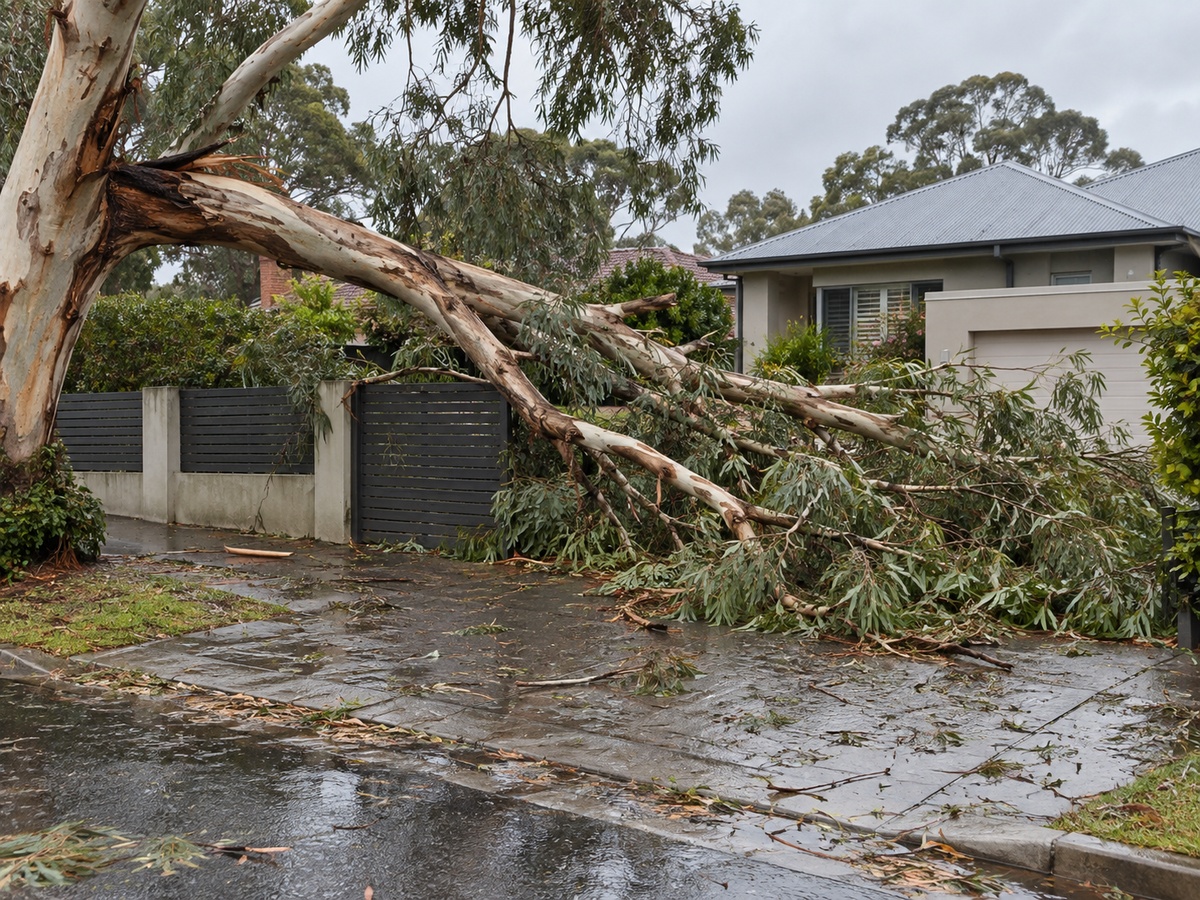
This is an emergency:
- a fallen tree;
- a tree or major limb on a house, roof or other structure;
- a tree or branch on a vehicle;
- a split or partially failed tree;
- hanging or failed branches;
- sudden root-plate movement; or
- active stem or branch failure.
This is not automatically an emergency:
- a leaning tree with no recent movement;
- an overhanging tree causing concern; or
- a declining tree with no active failure.
If there’s no immediate threat, a planned assessment is the right path, not emergency removal.
Can I Remove a Dangerous Tree Without Prior Council Approval?
Only in limited emergency circumstances.
Chapter E17’s exemption covers make-safe work where there’s an immediate threat, during or within 48 hours of a severe weather event. That’s a higher bar than “this tree looks dangerous.”
Where safe to do so, photograph the tree, the failed section, any visible defects and the surrounding damage before work begins. A follow-up application requirement applies after emergency pruning on private land, see below.
The 48-Hour Rule: What It Actually Covers
Chapter E17 exempts make-safe work carried out during, or within 48 hours of, a severe weather event, where there’s an immediate threat.
This is not a general 48-hour licence to remove any storm-affected tree. The test is still whether the work is genuinely needed to make the tree safe. A tree with minor storm damage that remains stable can still need the normal Permit or Council assessment pathway.
The 72-Hour Follow-Up Rule
This is the part most people miss.
For a tree on private land, Chapter E17 requires a Permit Application or Development Application to be lodged within 72 hours of the emergency works, for any further removal or pruning.
The emergency pathway is the start of the Council process, not the end of it.
Our Emergency Tree Removal Process
- 01Assess: the tree, the failure, the immediate hazard and site conditions.
- 02Make safe: removing a failed branch, an unstable limb, or the tree itself where necessary to reduce immediate risk.
- 03Document: photographs and arboricultural notes recording the tree’s condition and why emergency work was needed.
- 04Follow up: confirming whether a Permit, DA, Arborist Report or further approval is needed once the immediate hazard is resolved.
Fallen and Storm-Damaged Trees
We respond to:
- Fallen trees
- Trees on houses or roofs
- Trees or limbs on vehicles
- Trees across driveways
- Major storm-damaged limbs
- Split trees
- Hanging branches
- Root-plate failure
Not every storm-damaged tree needs full removal, where the remaining tree is structurally viable, pruning or another response may be possible once the immediate hazard is addressed.
Photograph the tree before work begins, where it’s safe to do so.
Why Documentation Matters
Emergency work can quickly remove the evidence of why it was necessary, the failed limb is gone, the hazard is cleared, and there’s nothing left to show Council what actually happened.
Where required, documentation can record the failure, structural defects, root-plate movement, storm damage, and the reasoning behind the make-safe decision. This also supports the 72-hour follow-up application where further pruning or removal is proposed.
Dangerous Tree or Emergency Tree? The Difference Matters
A tree can have decay, cavities, deadwood, structural defects, weak attachments or significant lean without presenting an immediate threat right now.
Treating an ordinary tree concern as an emergency just to bypass the normal Council pathway isn’t the right call, and it isn’t necessary either, since a planned assessment is usually faster than people expect.
A Tree Has Fallen on My House: What Now?
Safety first. Don’t go near an unstable tree or branch, and stay clear of areas where further failure could occur.
Once it’s safe to approach, work may involve removing unstable sections, creating safe access, and protecting the structure from further movement. Where Wollongong’s emergency provisions apply, document the tree and circumstances before the evidence changes, if it’s safe to do so.
A Tree Has Fallen Across My Driveway: What Now?
Restoring safe access usually comes first, without unnecessary work on parts of the tree that aren’t hazardous.
Once access is clear, the remaining tree gets assessed to determine whether further pruning, complete removal, safe retention, or a Council follow-up step is needed.
Can a Storm-Damaged Tree Be Saved?
Sometimes, it depends on what failed, how much canopy remains, trunk and root condition, and whether the tree can reasonably be managed going forward.
Once the immediate hazard is resolved, a Tree Health & Safety Assessment determines whether retention, pruning, monitoring or removal is the right call.
What If the Tree Is Dangerous but There’s Been No Storm?
The 48-hour severe-weather rule isn’t the only emergency basis.
Chapter E17 separately recognises action by Council, the SES, the RFS or another emergency or infrastructure authority responding to an immediate threat. For a private tree that seems dangerous but hasn’t failed and doesn’t fall within the severe-weather exemption, the normal Council pathway may still apply, if it’s unclear, get the tree assessed rather than assuming emergency removal is automatically permitted.
Emergency Tree Failures on Development Sites
Retained trees on a construction site can fail due to excavation, root damage, construction traffic, soil disturbance or storms.
Where a Project Arborist is appointed, emergency management should be coordinated with the site’s tree-protection requirements. Chapter E17 requires retained development trees to be protected through a Tree Protection Zone, with certification from an AQF Level 5 Arborist at specified construction stages.
Our Emergency Tree Services
- 24/7 emergency response
- Fallen tree assessment & removal
- Storm-damaged tree work
- Dangerous tree assessment
- Urgent make-safe work
- Hazardous limb removal
- Tree dismantling
- Emergency documentation
- Post-storm assessment
- Council follow-up advice
Emergency Tree Removal Throughout Wollongong
- Ward 1: Northern Wollongong24/7 emergency tree response throughout Helensburgh, Stanwell Park, Coledale, Austinmer, Thirroul, Bulli, Woonona and Corrimal, plus the northern parts of Fairy Meadow, Balgownie and North Wollongong.
- Ward 2: Wollongong & FigtreeEmergency tree removal and storm-damage response throughout Wollongong, Gwynneville, Keiraville, Figtree, West Wollongong and Mount Kembla, plus the southern parts of Fairy Meadow, Balgownie and North Wollongong.
- Ward 3: Dapto & Southern WollongongEmergency tree response throughout Dapto, Horsley, Wongawilli, Berkeley, Port Kembla, Windang, Coniston, Spring Hill, Lake Heights and Dombarton.
Some suburbs sit across a ward boundary, see Council's ward search to confirm. All suburbs listed fall within the Wollongong City Council LGA.
Why Choose Wollongong Tree Permit Services?
24/7 Emergency Response
Assistance for fallen, storm-damaged and immediately dangerous trees.
Consulting Arborists
Professional assessment and arboricultural documentation where required.
Emergency Tree Work
Make-safe work, hazardous limb removal and emergency removal where appropriate.
32+ Years’ Experience
Practical arboricultural and tree-removal experience.
Wollongong Council Knowledge
Understanding of Chapter E17’s emergency make-safe and follow-up requirements.
Council Follow-Up Support
Help determining whether a Permit, DA or further approval is needed once the emergency is resolved.
Frequently Asked Questions
Can I remove a dangerous tree without Council approval?
Only in limited emergency circumstances. Chapter E17 allows make-safe work where there’s an immediate threat, including the specific severe-weather provision. Follow-up Council requirements can still apply.
What qualifies as an emergency tree?
A fallen tree, active structural failure, major storm damage, root-plate movement, split stems or major hanging branches. A concerning but stable tree needs a planned Tree Health & Safety Assessment instead.
What is Wollongong’s 48-hour rule?
Chapter E17 recognises make-safe work where there’s an immediate threat, during or within 48 hours of a severe weather event. It’s not a blanket exemption for every storm-damaged tree.
What happens after emergency pruning?
For a private-property tree, a Permit Application or DA must be lodged within 72 hours of the emergency works, for any further removal or pruning.
Should I take photos before emergency work?
Yes, where it’s safe to do so, they document the failure and site conditions before the scene changes.
Can you provide an Arborist Report after storm damage?
Yes, where required, recording the tree’s condition, defects and the circumstances of the emergency work.
Does a leaning tree automatically count as an emergency?
No. A lean alone doesn’t establish an immediate threat, recent movement, root-plate disturbance or cracking might change that, but each tree needs its own assessment.
Can a storm-damaged tree be saved?
Sometimes, if the remaining tree is structurally viable after the immediate hazard is addressed, pruning or monitoring may be possible instead of full removal.
Need Emergency Tree Removal in Wollongong?
If a tree has fallen or presents an immediate threat to people or property, call us now. For anything less urgent, send us the details for a free quote.
Get a Free Quote 0494 077 630