Wollongong Development Tree Compliance
From Development Approval to Construction Certification, Managing Trees Through the Build
Got a Wollongong DA involving existing trees, and now need to know what actually happens on site once consent is issued?
Chapter E17 requires tree and vegetation impacts connected to development to run through the development approval process rather than a standalone tree permit, and for many projects, that’s only the first stage. Where trees are approved for retention, Chapter E17 also sets out what has to happen through construction: a Tree Protection Zone established and maintained, and arborist certification at defined points before, during and after the build.
This guide focuses on that construction-phase compliance sequence, what needs to be in place before the first excavator arrives, what changes if the plans shift mid-build, and what “complete” actually looks like at the end.
For the earlier question, do I need a DA at all, and what report do I need to get one, see our Wollongong Tree Removal & Pruning Guidelines.
The Wollongong Development Tree Compliance Sequence
Steps 1–4 are usually settled well before construction, the rest of this guide focuses on steps 5 onward, where compliance actually gets tested on site.
What Should Be in Place Before Construction Starts?
Before anything happens around a retained tree, the approved arboricultural requirements need checking against the actual site, not just against the plans.
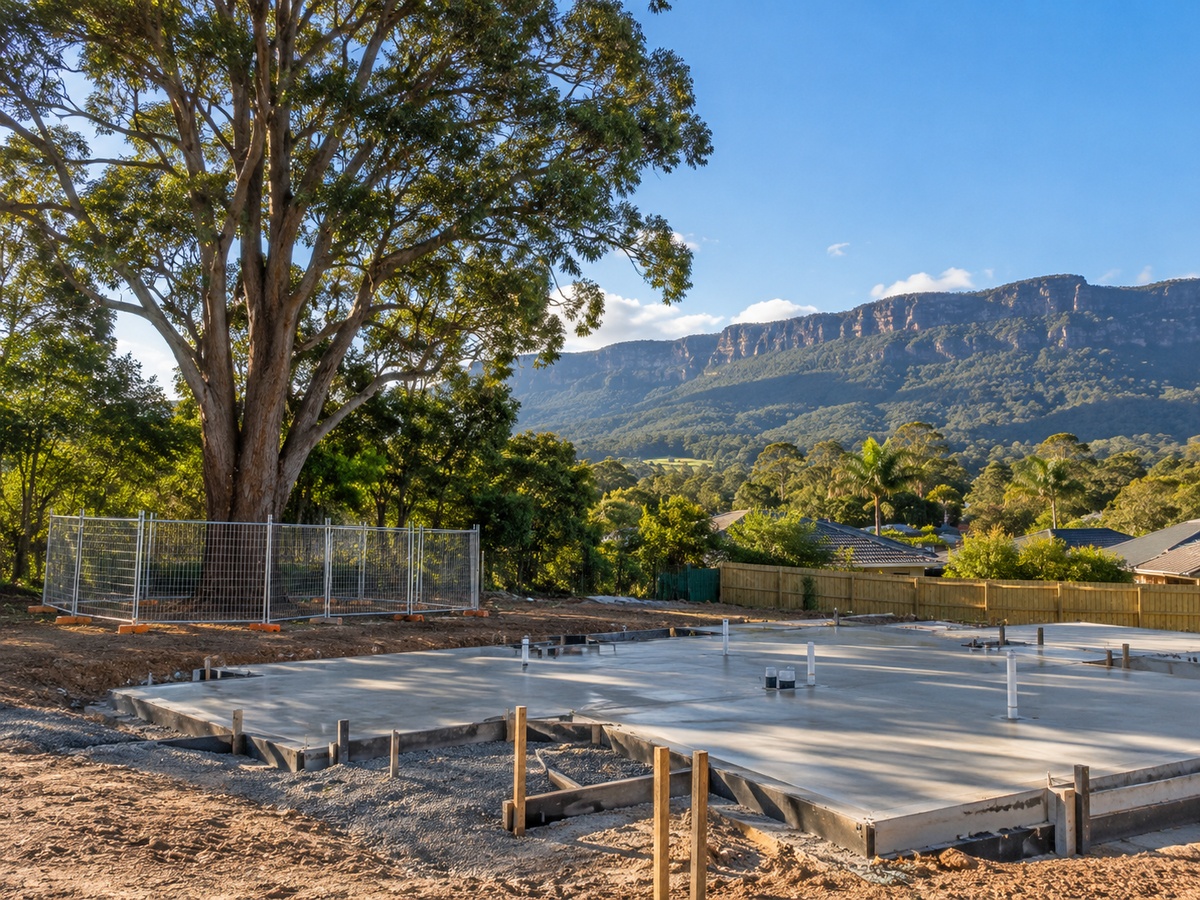
That means confirming which trees are retained, checking the TPZ is correctly located, installing protection fencing, identifying restricted construction areas, confirming access routes, and reviewing proposed excavation against known root zones. Chapter E17 requires the protection area to stay clear of buildings, footings, excavation, retaining walls, material storage, services, level changes and hard surfaces for the full construction period, which only works if it’s actually set up correctly before the site gets busy.
Getting this right at the start meaningfully reduces the chance of a non-compliance issue turning up later, when it’s harder and more expensive to fix.
Construction Certification: the Three Stages
Chapter E17 requires certification from an AQF Level 5 Arborist at three points where trees are being retained and protected:
This means tree compliance usually isn’t a single report filed before the site starts, on most projects with a retained tree, it’s an ongoing obligation that runs the length of the build.
What If the Plans Change Mid-Construction?
Changes to building levels, excavation depth, a retaining wall, a driveway alignment or a service route can change the arboricultural picture even when the change looks minor from a construction standpoint, a shift that seems small on paper can bring works closer to a retained tree or straight into a protected root zone that was never meant to be touched.
Where an approved Tree Protection Plan or AIA is already in place, any change affecting a retained tree should be reviewed before work proceeds, not after. Depending on what’s changed, the response might mean additional protection measures, arborist supervision of the specific work, root investigation to check what’s actually below ground, or in some cases a design change. The point is dealing with the conflict before the tree or its roots are actually damaged, after the fact, there’s often nothing left to protect.
When Does Root Investigation Matter During a Build?
A TPZ is a calculated zone, actual root distribution on site can differ from the calculation, depending on soil conditions, existing structures, past excavation, compacted surfaces or underground services already in the ground.
Root investigation earns its place where proposed works genuinely enter the calculated protection area: a driveway close to a tree, a footing or retaining wall inside the TPZ, plans showing a significant encroachment, or Council asking for more evidence before it will sign off. What it establishes, actual root location rather than a theoretical zone, can be the difference between a design that needs to change and one that’s fine as drawn.
Can a Retained Tree Later Be Removed With a Standard Permit?
No, not normally.
Chapter E17 is explicit that a standard Permit cannot approve removal of a tree that a development consent requires to be retained. Where that conflict turns up, often when a builder or owner discovers mid-project that a “problem” tree is actually a consent-protected one, a modification of the development consent is what’s needed, not a tree permit application.
Check the original approval before assuming removal is straightforward. This comes up most often when a tree conflict is discovered after consent has already been issued, rather than caught during design.
Native Vegetation, Biodiversity & Riparian Land
Development involving trees can extend past ordinary arboricultural matters. Chapter E17 declares certain mapped native vegetation, threatened-species habitat, heritage vegetation, and vegetation within a riparian zone or within 40 metres of the top bank of a creek, river, watercourse, wetland, stream or other aquatic habitat.
Where clearing triggers the NSW Biodiversity Offset Scheme threshold, the DA needs a separate Biodiversity Development Assessment Report from an accredited assessor, an Arborist Report doesn’t substitute for that. On a site near a waterway or with mapped vegetation, it’s worth identifying this early rather than assuming a standard tree assessment covers it.
What Do We Need From You?
To assess a Wollongong development site, send us:
- Current survey
- Architectural or development plans
- Site plan
- Proposed driveway and access details
- Excavation and retaining-wall details where available
- Any Council correspondence
- DA conditions, if consent has already been issued
From there we’ll confirm whether you need a Development Arborist Report, AIA, Tree Protection Plan, Root Investigation, Project Arborist, or construction certification, and at which stage of the sequence above you actually are.
Official Council Source
Wollongong City Council, Wollongong DCP 2009, Chapter E17: Preservation and Management of Trees and Vegetation
The version referenced throughout this site is the amendment in force from 1 July 2023.
Used for development approval pathways, tree retention and removal assessment, Tree Protection Zones, construction certification and related vegetation controls.
Need a Wollongong Development Arborist?
Send us your plans and any consent conditions, and we’ll confirm what your project needs and provide a fixed quote.
Get a Free Quote 0494 077 630